
Artificial intelligence is increasingly present in schools, but during state testing week, its use in hallway posters sparked debate instead of motivation.
Around the time of state testing — March 30 to April 2 — administrators rolled out a campaign of AI-generated posters to encourage students to take state assessments seriously. The goal is clear —to boost participation, effort, and scores. But the execution raised more questions than motivation.
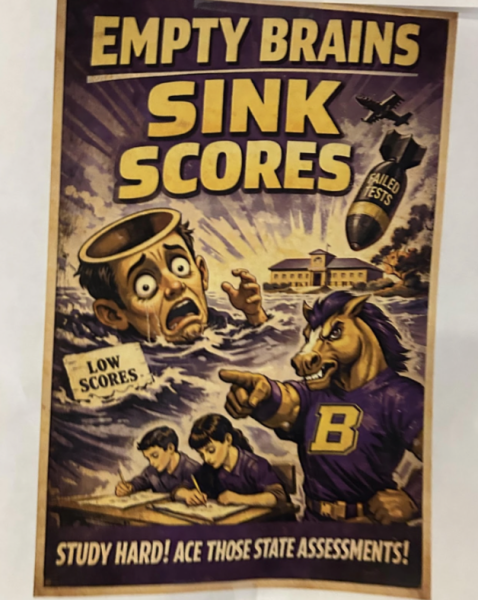
Students noticed the irony immediately. These assessments are designed to measure skills like writing, analysis and critical thinking — the same skills AI tools increasingly replicate.
“We’re told these assessments measure critical thinking…yet tools powered by AI are quickly becoming capable of handling those same tasks,” said Macey Chaulk, 12.
Others argued the issue is not AI itself but how it is used. Mallory Marmon, 12, points out that the posters are only one part of a larger push that includes assemblies, incentives, and even free food.
“I think the AI posters are really weird, especially the one where a nuke is about to hit the high school,” Marmon said. “The concern is not just about technology, but about authenticity. When encouragement starts to feel like bribery, students are less likely to take it seriously.”
There was also a missed opportunity. Madi Brown, 12, highlights that these posters could have showcased student creativity instead.
“This could have been a great learning opportunity for graphic design students,” Brown said.
In a school full of talented artists and designers, outsourcing creativity to AI sends the wrong message about whose work is valued.
Still, not every reaction is negative. Some students, like Kayley Tran, 12, see the effort as harmless and even well-intentioned.
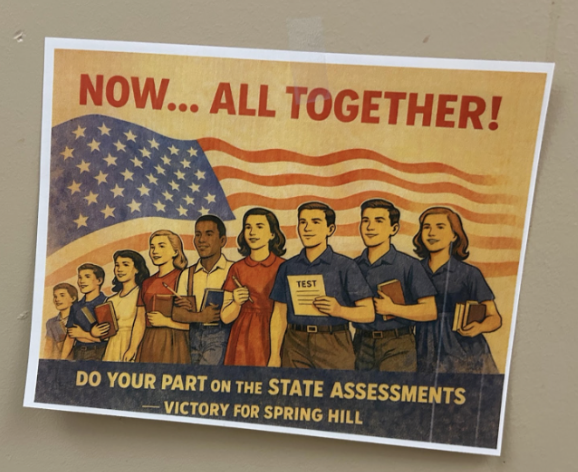
“The goal seemed more about school spirit and making testing feel less stressful,” Tran said.
The posters, while confusing at first, were meant to bring humor and reduce stress. And in a high-pressure testing environment, that intention matters.
But intention alone is not enough. The message felt inconsistent, discouraging AI use in classrooms while promoting it in hallways.
“How can kids be expected to care about assessments if their adults aren’t responsible enough to ethnically encourage them?” asked Dylan Estes, 12.
State testing does not need propaganda-style posters to matter. It needs clarity, consistency, and trust. Right now, the campaign misses that mark.
If schools want students to care about their performance, the approach should reflect the same values being tested: effort and critical thinking. Otherwise, the message risks getting lost no matter how eye-catching these posters could be.